
By Dr. Syeda Sara Tajammul
Abstract:
Introduction
Extramedullary haematopoiesis (EMH) is the abnormal
formation of blood cells outside the bone marrow, occurring as
a compensatory response to insufficient or increased
destruction the blood cell, such as in haemolytic disorders like
sickle cell disease (SCD). In SCD, sickled red cells cause
haemolysis and chronic anemia, prompting EMH. Spinal cord
compression (SCC) due to epidural EMH is an exceptionally
rare but serious complication, presenting with back pain,
neurological deficits, and potential paralysis. Prompt
diagnosis, best achieved with MRI spine is critical to prevent
irreversible damage. Management typically includes red cell
transfusions, radiotherapy, surgery, and systemic treatments
(steroids, hydroxyurea). Radiotherapy is particularly effective
due to the radiosensitive nature of hematopoietic tissue,
offering good outcomes with minimal toxicity.
Case Discussion
A 43-year-old man with homozygous sickle cell anemia (Hb
SS) complicated by extramedullary haematopoiesis (EMH) and
cirrhosis from sickle cell hepatopathy developed progressive
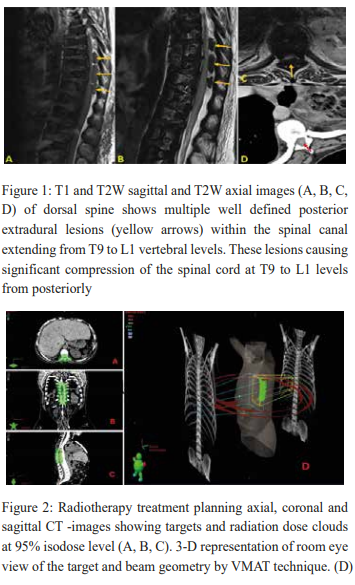
weakness, constipation, and urinary retention. MRI revealed
multiple extradural lesions from D9–L1 causing spinal cord
compression (Figure 1), consistent with EMH. Due to
contraindications for transfusion (chronic liver disease, iron
overload) and inoperability, he was treated with palliative
radiotherapy to a dose of 18 Gy in 10 fractions by VMAT
technique (Figure 2). He exhibited clinical improvement in
bladder and bowel function but continued to have trouble
walking. MRI scan performed post-radiotherapy at 3 months
showed stable disease with a slight reduction in the size,
enhancement, and mass effect of the extradural spinal lesions in
the lower spine. He remained under the care of the clinical
haematology team for ongoing management of sickle cell
disease but unfortunately, he could not survive and expired
after 6 months due to the sickle cell disease related
complications.
Conclusion
The optimal treatment for spinal cord compression due to
extramedullary haematopoiesis (EMH) in sickle cell disease
remains unclear, as current knowledge is largely extrapolated
from other hematologic disorders like thalassemia. Further
research focused on this context is needed. Low-dose
radiotherapy appears to be an effective option, and
multidisciplinary collaboration is crucial to improving
management and outcomes.