By Dr. Zainab Rafat
Abstract:
Introduction
Pituitary adenomas are common benign intracranial neoplasms that can cause significant morbidity through hormonal
dysfunction or optic apparatus compression. While
microsurgical resection remains the primary treatment, residual
or recurrent disease is common, particularly in tumors invading
the cavernous sinus or parasellar regions. Stereotactic
radiosurgery (SRS) provides a minimally invasive alternative
with proven tumor control; however, single-fraction SRS near
the optic chiasm carries a risk of visual compromise.
Hypofractionated or multisession SRS offers a safer approach,
maintaining efficacy while minimizing optic toxicity. This
study presents the institutional outcomes of patients with
pituitary adenomas treated with multisession SRS at the
Neurospinal and Cancer Care Institute (NCCI), Karachi,
emphasizing long-term efficacy, toxicity, and visual outcomes.
Methods
A retrospective review was conducted on 113 patients with
pituitary adenomas (81 males, 32 females) treated with
multisession SRS over 7 years. Treatments were delivered on
an Elekta Synergy-S linear accelerator using a 3 mm
micro-multileaf collimator and cone-beam CT guidance. The
prescribed dose ranged from 20–25 Gy in five fractions,
delivered to an isodose line of 80–85%. Patients underwent
MRI and endocrinological assessment at 3 and 6 months, then
biannually. Visual fields were assessed by perimetry before and
after treatment. Data were analyzed using SPSS v29, with
survival estimated via the Kaplan–Meier method.
Results
The mean age was 43.2 ± 11.5 years. Most (71.7%) had
non-functioning adenomas, while 28.3% were
hormone-secreting. Tumor volume reduction occurred in 65%,
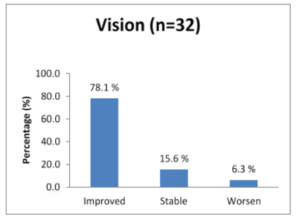
stability in 28%, and progression in 7%. Visual improvement
was documented in 42%, stability in 56%, and deterioration in
only 2%. Endocrinological normalization was achieved in 38%
of functioning adenomas. Acute toxicity was minimal, with no
cases of radiation-induced optic neuropathy or pituitary
apoplexy. The 5-year overall survival was 86%, with a mean
survival of 3.5 years (95% CI: 3.12–3.85). Local control
exceeded 90% at 5 years, aligning with international data.
Conclusion
Multisession SRS offers excellent tumor control and visual
preservation for pituitary adenomas, including lesions near the
optic apparatus. The regimen is safe, effective, and
well-tolerated, providing a valuable alternative to repeat
surgery or single-fraction SRS. These outcomes support fractionated SRS as a standard, low-toxicity option for
complex or recurrent adenomas.
Visual outcomes on perimetry post treatment.