By Dr. Khadija Afzal
Abstract:
Background:
Keloids are benign dermal tumours with high recurrence rates
after surgical excision alone. Adjuvant radiotherapy, including
high dose rate brachytherapy has shown promising results in
reducing recurrence, but optimal dosage and fractionation
schedules remain a subject of investigation. This study was
conducted to assess the efficacy and safety of postoperative
high-dose-rate (HDR) brachytherapy in a cohort of patients.
Material and Methods:
The study was conducted on 24 patients (20 females and 4
males) with an average age of 29.5 years from Jan, 2024 to Jun,
2025. In total, 30 keloids – as six patients had two keloids –
were treated with complete surgical excision (keloidectomy)
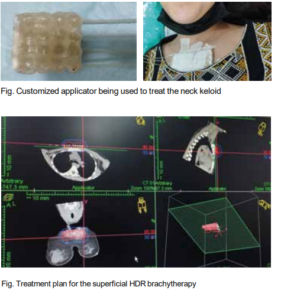
followed by superficial surface mould HDR brachytherapy
using Iridium -192 sourcce and a custom-fabricated applicator
of embedded catheters. The customised applicator was placed
on the skin to match the area of surgical wound. The majority
of keloids were located on the External Ear i.e. pinna (10) and
ear lobe (11), followed by on Chest (8) and neck (1). The
treatment plan was made using Oncentra software on acquired
CT dataset. A total dose of 10 Gy in 1 fraction for ear lobe and 18gy in 3 fractions (6 Gy per fraction) to lesions in other areas
was delivered within 24 hours of surgery. The primary endpoint
was local control (recurrence-free survival), and secondary
endpoints included cosmetic outcomes and treatment-related
toxicities (scored via CTCAE criteria). Based on treatment
timing the follow up duration in the study ranged from 6 to 23
months.
Results:
With a median follow-up of about 13 months, there were no
recurrences reported. Cosmetic outcomes were rated as
excellent or good in 79% of patients treated. The only side
effect observed was Grade 1 acute radiation dermatitis in 54%
patients, while no Grade 3 or higher acute or late toxicity was
observed.
Conclusion:
Our institutional experience suggests that the adjuvant
brachytherapy regimens (10Gy single fraction for earlobe and
18Gy/3fractions elsewhere) lead to excellent short to midterm
local control with minimal toxicity.